
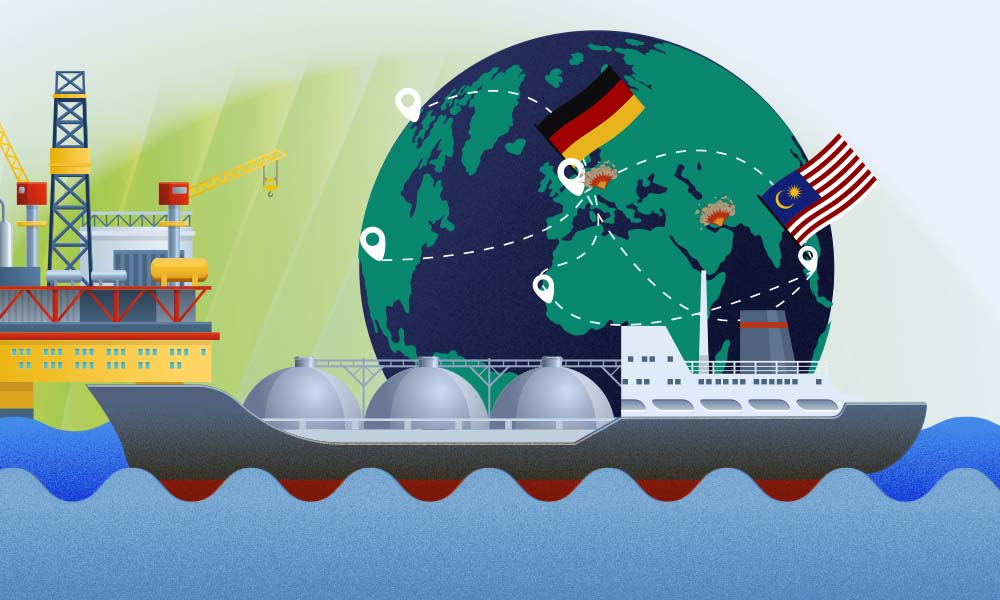
Kuala Lumpur, 17 October 2026: The Institute for Democracy and Economic Affairs (IDEAS) today released its latest report, Critical Choices: How Malaysia and Germany Can Navigate Shifting Energy Geostrategy, which examines opportunities for Malaysia and Germany to strengthen energy security cooperation amid evolving global energy, trade and financial dynamics.
Released in conjunction with IDEAS’ Liberalism Conference 2026, the report draws on the experiences of both countries to identify lessons and opportunities for collaboration in energy policy. Co-authored by IDEAS Director of Research Dr Stewart Nixon and Malte Küper, Senior Economist at the German Economic Institute, the study examines shifting energy geostrategy and considers how Malaysia and Germany can work together as participants in interconnected global markets.
Malaysia and Germany face an increasingly hostile, volatile, and uncertain environment surrounding energy choices. Major disruptions to tanker traffic in the Strait of Hormuz have built upon the continuing energy fallout from Russia’s invasion of Ukraine. The United States’ military and economic coercion has become a destabilising force and China’s rising green manufacturing and critical minerals dominance creates a different type of energy dependency. Policymakers are contending with repeated energy shocks, rivalrous geopolitics, and clean transition imperatives on a perpetual crisis footing, and risk repeatedly treating short-term symptoms instead of investing in preparedness efforts and comprehensive resilience strategies. Shocks end up causing more economic, political, and social damage than they should.
The report helps shift policymaker focus by:
- Exploring the significance of sharpening US energy policies and China’s renewables dominance in the context of wider energy and geopolitical trends;
- Evaluating the experiences of Malaysia and Germany to investigate the impacts and different interpretations of and policy responses to these shifts; and
- Highlighting key lessons and identifying areas where Malaysia and Germany can cooperate further.
“Energy risk lies not only in the supplier, but in whether infrastructure enables energy source flexibility. Analysis of dependence must assess the tradability of the energy source, not import shares alone. And as both German and Malaysian experience shows, responses to energy crises need to be more time-limited, precisely targeted, and tied to structural reforms,” emphasised Malte Küper.
The report presents several shared learnings to boost domestic policies and many opportunities to forge bilateral and plurilateral cooperation towards enhanced energy security, including to:
- Develop clearer national strategies surrounding energy risk, resilience, and reward trade-offs, engaging both preparedness and response actions and deeper market intelligence and strategic foresight;
- Pursue bilateral and plurilateral cooperation towards mutually beneficial and binding agreements that facilitate joint preparedness and collective shock response efforts;
- Recognise that absorption-centric shock responses with untargeted subsidies are unsustainably expensive and blunt incentives that encourage more resilient choices;
- Better appreciate and guard against familiar and emerging dependencies: disruptions to cross-border fossil fuel flows and supply chains for renewable energy technology and products that support mostly domestic energy production; and
- Accelerate renewable energy installation to reduce the risk and impact of disruptions like the West Asia crisis, noting the limits of diversification and domestic production.
“That none of the Russia-Ukraine, West Asia, or other recent trade and pandemic shocks have prompted deeper market, supply chain, and scenario-based intelligence analysis by policymakers is concerning and leaves Malaysia more economically vulnerable to future shocks than it otherwise could be. Malaysia cannot continue to rely on unsustainable and untargeted subsidies that provide temporary relief but preserve a status quo that will never return. It must work with partners like Germany to build clearer strategies, concerted preparedness efforts, and policy mechanisms for targeting support,” said Dr Stewart Nixon.
Download the full report on our website.
— ENDS —
Download the Media Statement PDF File Here
For enquiries, please contact:
Ryan Panicker
Pengurus, Advokasi dan Program
T: 03 – 2070 8881/8882 | E: ryannesh@ideas.org.my

Malaysia needs a sustainable budget, not a sugar hit