
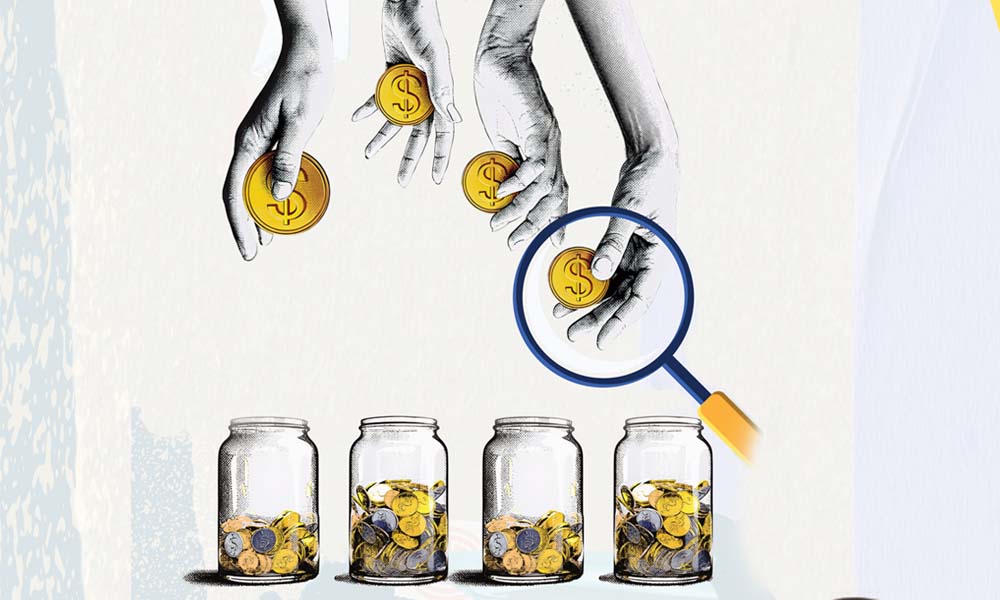
Kuala Lumpur, 25 June 2026: The Institute for Democracy and Economic Affairs (IDEAS) launched a new policy paper, The Governance of Fiscal Transfers in Malaysia: Is it rule-based, predictable, and transparent?, highlighting the need for all federal-state transfers to have firm legal foundations, clear allocation formulas, and be consistently and accessibly disclosed across federal and state budget documents.
The report was launched in conjunction with IDEAS Fiscal Responsibility Summit 2026, organised with the support of the European Union Delegation to Malaysia. The summit brought together policymakers, researchers, experts, and civil society representatives to discuss the importance of responsible fiscal governance and sustainable public finance management in Malaysia.
The event also featured a keynote address by Deputy Minister of Finance, YB Liew Ching Tong, who shared perspectives on the importance of responsible fiscal governance in strengthening Malaysia’s economic resilience, supporting long-term development, and ensuring effective cooperation between different levels of government.
The report authored by Sri Murniati Yusuf, IDEAS Senior Fellow examines whether Malaysia’s fiscal transfer system operates according to clear rules, provides predictable funding to state governments, and meets accepted standards of transparency.
The study finds that Malaysia’s fiscal transfer system is not fully rules-based, highly unpredictable for state governments, and only partially transparent. While several transfers are grounded in clear constitutional provisions, others lack a clear legal basis, publicly available guidelines, or transparent allocation formulas. In some cases, transfers are not disbursed according to their stated formulas, creating uncertainty and raising concerns about consistency and fairness.
The report also finds that transfer allocations can vary significantly from year to year, with substantial differences between projected and actual disbursements. As a result, state governments often face difficulties in planning expenditure and managing their finances due to uncertainty surrounding transfer revenues.
In addition, the recording of transfers across multiple federal and state budget documents makes it difficult to determine the full extent of federal support to states, limiting transparency, public scrutiny, and accountability.
“Fiscal transfers play a critical role in supporting state governments and ensuring the delivery of public services. However, the effectiveness of these transfers depends not only on the amount allocated, but also on whether they are governed by clear rules, predictable arrangements, and transparent reporting mechanisms. Strengthening these governance dimensions is essential to building trust and improving intergovernmental fiscal relations,” said Sri Murniati.
To strengthen the governance of fiscal transfers, the report recommends:
- Strengthen the legal, formula-based, and guideline framework of transfers by ensuring:
- All transfers are explicitly anchored in constitutional or statutory provisions;
- All transfers are supported by clear and publicly available guidelines; and
- All transfers should have well-defined eligibility criteria and transparent calculation formulas.
- Establishing a dedicated technical secretariat or committee under the National Finance Council (NFC) to facilitate continuous federal-state engagement, support implementation, and address operational challenges in transfer administration.
- Enhancing transparency and comparability of fiscal information by harmonising the reporting and disclosure of transfer data across federal and state budget documents.
“The European Union is pleased to support this study and contribute to the debate on how to strengthen fiscal governance, ensure transparency and effective public institutions. We believe that such high-quality research is an investment in our joint future, allowing us to share best practices and identify common interests. Building resilient institutions fosters sustainable growth – a shared interest of the EU and Malaysia and a cornerstone of our deepening partnership,” said HE Rafael Daerr, Ambassador of the European Union to Malaysia.
For more information, download the full report here
— ENDS —
Download the Media Statement PDF File Here
For enquiries, please contact:
Ryan Panicker
Manager, Advocacy and Events
T: 03 – 2070 8881/8882 | E: ryannesh@ideas.org.my

Belanjawan berdaya tahan