
Kuala Lumpur, 30 April 2026: IDEAS’ latest study, titled ‘Federal Transfers and Fiscal Capacity in Malaysia: Evidence on Equalisation Across States’, written by Nor Nazirah Mohamed, reveals that Malaysia’s intergovernmental transfer system does little to reduce revenue-raising and economic disparities between states. It provides further evidence that Malaysia’s highly centralised fiscal system is not sufficiently targeted to allocate funds according to economic development needs.
Despite the criticality of transfers to a well-functioning federated fiscal system, evidence of whether transfers in Malaysia address differences in revenue-raising capacity between different levels of government is scarce. Federal transfers to states should address imbalances between the taxation and borrowing powers at the federal and state levels, with allocations by state reflecting interstate revenue-raising and development gaps. This study analyses whether transfers perform this ‘equalisation’ function, providing greater allocations to states with lower fiscal capacity.
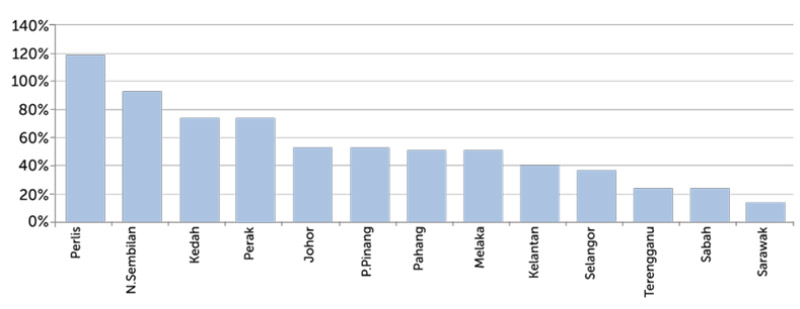
The findings first illustrate the significant variance in states’ dependence on federal transfers. The structural mismatch between states’ expenditure responsibilities and their limited revenue-raising powers is most serious in Terengganu, Perlis, and Kelantan, where own-source revenue as a share of expenditure exceeds 50% (Figure 1). Perlis, Negeri Sembilan, Kedah, and Perak meanwhile, exhibit the greatest dependence on fiscal transfers as a share of revenue at over 70%, while dependence is relatively low for Sabah and Sarawak (Figure 2).
Figure 1: Structural Reliance on Transfers for Expenditure Across States (Average 2019-2024)
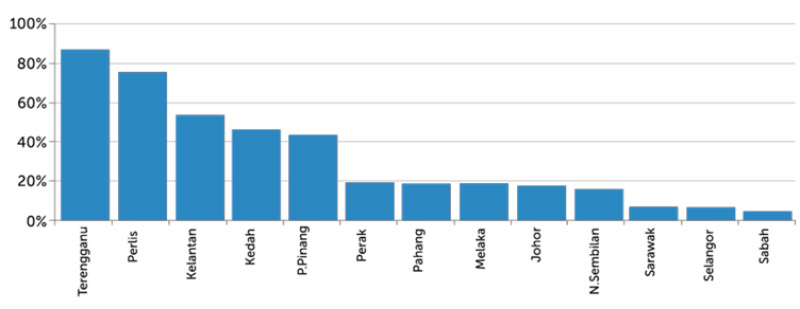
Figure 2: Dependence on Transfers as Revenue Source Across States (Average 2019-2024)
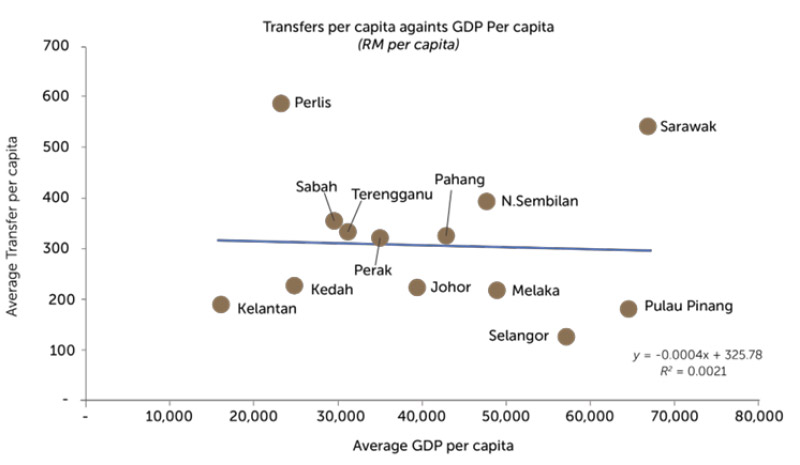
The research also shows that while transfers somewhat reduce disparities, the distribution of federal transfers is not systematically aligned with underlying fiscal capacity. Across indicators including GDP per capita, average household income, and economic structure, states like Kelantan and Kedah receive lower transfers than what would be expected given their low fiscal capacity (Figure 3). Conversely, Sarawak receives significantly higher per capita transfers than its economic strength would imply.
Figure 3: Federal Transfers and GDP Per Capita Across States (Average 2019-2024)
The research also shows that while transfers somewhat reduce disparities, the distribution of federal transfers is not systematically aligned with underlying fiscal capacity. Across indicators including GDP per capita, average household income, and economic structure, states like Kelantan and Kedah receive lower transfers than what would be expected given their low fiscal capacity (Figure 3). Conversely, Sarawak receives significantly higher per capita transfers than its economic strength would imply.
“Malaysia’s mosaic of largely uncoordinated expenditure-based transfers results in outcomes that have almost no relationship with the differing revenue and economic needs of states. The largest single transfer — for state road maintenance —actually rewards more developed states for their extensive road networks,” said Nor Nazirah Mohamed, Research Manager at IDEAS and lead author of the study.
Structural reform of the fiscal transfer system remains critical to achieving fairer and more sustainable allocations. Malaysia needs a more coherent and transparent needs-based model that accounts for demographic pressures, economic development levels, and location-specific service delivery requirements. Continuing to ignore the need to improve data collections and advance evidence-based targeting of transfers will entrench and widen disadvantages between states, against the spirit of federation.
“Transfers should support all states to provide comparable levels of public services, recognising underlying differences in states’ ability to raise revenue. Transfers must help increase economic activity in less developed states, not reward existing activities in larger states,” says Dr Stewart Nixon, Director of Research at IDEAS.
For more information, please download the full report Here
For enquiries, please contact:
Ryan Panicker
Manager, Advocacy and Events
T: 03 – 2070 8881/8882 | E: ryannesh@ideas.org.my

Good policies need good communication