
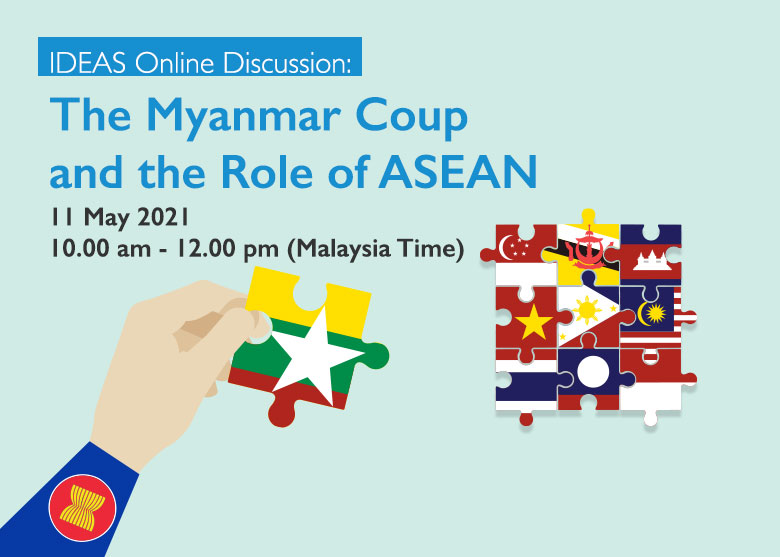
On 11th May 2021, IDEAS conducted an online event titled “IDEAS Online Discussion: The Myanmar Coup and the Role of ASEAN”. Four knowledgeable speakers, namely Eric Paulsen, Lilianne Fan, Moe Thuzar and Khine Win, joined the moderator, Zokhri Idris, as the discussion attempted to understand how the crisis threatens Myanmar’s internal unity and regional centrality. The panel also keen to explore what role can ASEAN plays in bringing all main stakeholders, both inside and outside Myanmar, to the negotiating table.
Eric Paulsen, Representative of Malaysia to the ASEAN Intergovernmental Commission on Human Rights (AICHR), kicked off the discussion by mentioning the 5-point consensus reached by ASEAN leaders convening on 24th April 2021. The consensus is an immediate cessation of violence; constructive dialogue among all parties concerned; a special envoy of ASEAN-chaired to lead mediation with the assistance of the Secretary-General; ASEAN to provide humanitarian assistance; and special envoy and delegation to Myanmar. However, he reminded that even though several member states have called for it, the release of Aung San Suu Kyi and the other political prisoners is still missing from the agreement.
Mr Paulsen reiterated that this is only the first step in opening the door to the mediation process. The National Unity Government (NUG) and the other legitimate stakeholders would eventually have to be consulted if there is a genuine and inclusive dialogue process. The challenge now is to hold the regime to the commitments it has made, considering Tatmadaw has already backtracked from the consensus. He also warned that an all-out civil war is a disaster in the making as the repercussions will be far-reaching beyond Myanmar borders, threatening peace, stability, security and ASEAN. Despite that, he maintained ASEAN is probably best placed to reach out to Tatmadaw as the UN and others are working on different tracks to resolve the crisis.
Lilianne Fan, International Director and Co-Founder of Geutanyoe Foundation, said that among ASEAN, Indonesia, Malaysia, and Singapore have been much stronger in condemnation of the violence in Myanmar. She pointed out two main elements from the 5-point consensus; political dialogue and humanitarian aid. Stopping violence is the essential condition for both to happen. She also commented that this is unchartered territory for ASEAN as it has made commitments to work on issues it does not have strong history like political dialogue, facilitating conflict situations and providing humanitarian assistance not in cases of natural disasters.
ASEAN needs to listen to experts from Myanmar who understand the conflict and its dynamics as this is a highly complex tapestry involving different stakeholders. She also mentioned that ASEAN needs to do a preliminary assessment of humanitarian needs and be equipped with ongoing situation analysis. Lastly, she called for us to look at where ASEAN member states as well as ASEAN stakeholders, including think tanks, can contribute to looking at elements not included in the consensus like transnational crimes.
Moe Thuzar, Fellow at ISEAS-Yusof Ishak Institute and Co-coordinator of Myanmar Studies Programme, listed four key points that ASEAN has to focus on. They are stability, statement, stakeholders, and substantive support. Ms Moe stated that current instability is presenting additional challenge for Myanmar. The triple crises that Myanmar currently faces are political, economic and social. She also called ASEAN to look at the contrast in the statements that both NUG and SAC have issued, the intent and commitments behind the statements.
According to her, ASEAN would require a new kind of shuttle diplomacy that the envoy and delegations need to shuttle between different key stakeholders in Myanmar and ASEAN governments. As for substantive support, she calls for ASEAN situation to be looked at as a coordinating platform and engaging the international community for helping Myanmar and its people.
Khine Win, Director of Sandhi Governance Institute, said that public emotions are currently very high. ASEAN needs to understand the regime’s characteristics as public opinion now is that the military regime is using ASEAN to its advantage. He stressed that ASEAN must prove its impartiality and respect Myanmar’s people or lose its integrity. He also urged ASEAN to engage multi-stakeholders and be aware of domestic politics as spillover effects of instability in Myanmar will be huge.
For those who missed the webinar session and would like to watch it, the video recording of the webinar is available below.
